
Trading journalKeep the plan
Keep the plan
beside the result.
Use pre-trade notes for the original trigger and risk. Add execution, lessons and screenshots in the post-trade review.
See the trading journal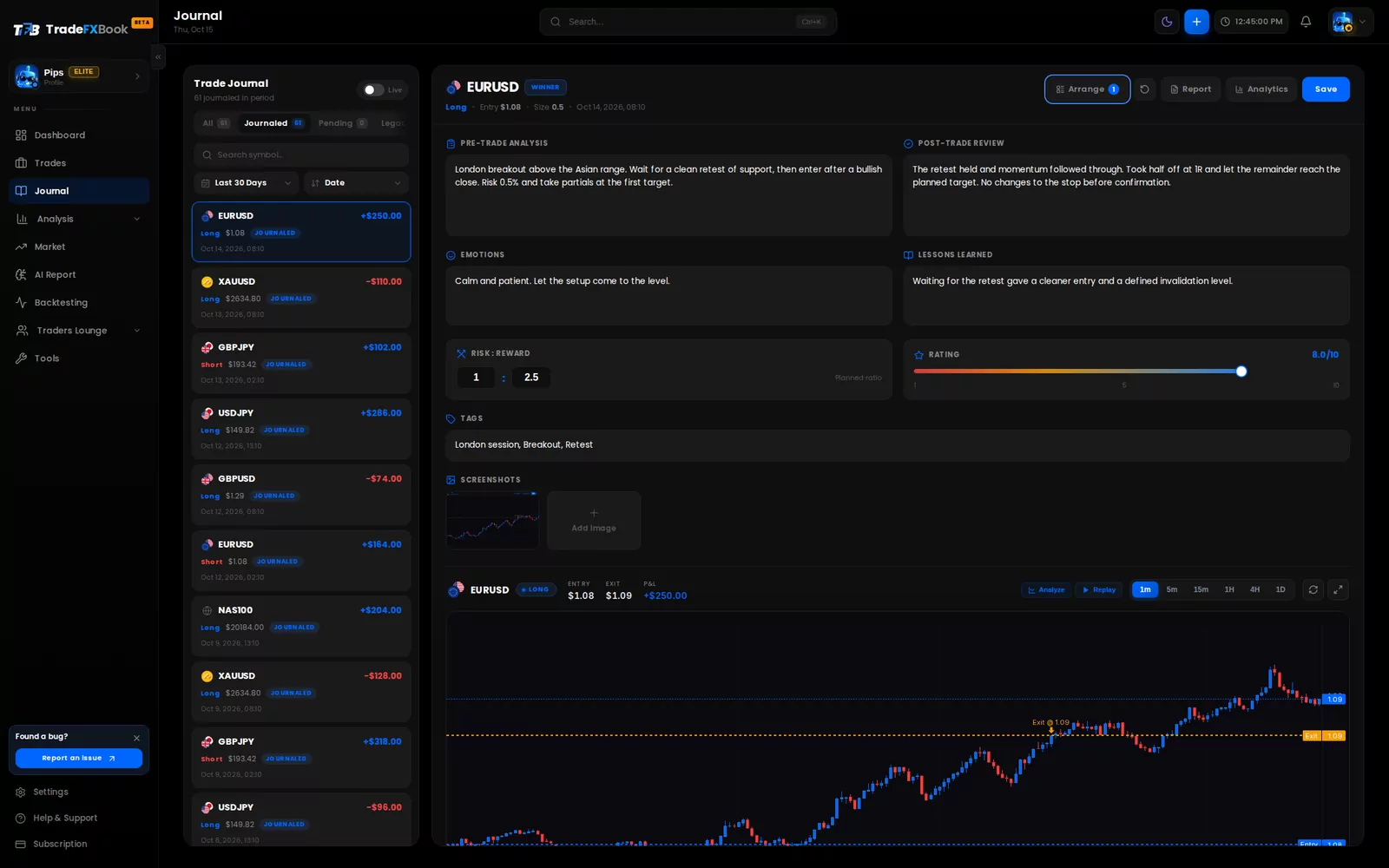
Forex trading guides
A useful journal preserves the decision as well as the result. Start small enough to keep doing it, then review what your records actually show.
A broker statement tells you what traded. A journal should also tell you why. If the explanation is written only after the result, it is easy to turn a lucky winner into a good decision or an ordinary loss into a mistake. Put the plan down while the outcome is still unknown.
Choose a small set of fields you can complete consistently. Include the account, pair, direction, date, time and timezone. Give the setup a stable name.
Then describe the condition that makes the trade valid and the price or event that would make it invalid. “It looked strong” is hard to review. “A completed candle closed above the range, then the retest held” gives you something to check.
Write the management rule before the trade too. If you intend to move a stop after a particular price move, say when and why. Otherwise a later change can look planned simply because you remember it that way.
Consider a hypothetical USD account with a $10,000 balance. The trader chooses 0.5% as the price-risk budget for this example: $50. They plan to buy EURUSD at 1.08500, with a stop at 1.08300 and a target at 1.08900. This is an illustration of the calculation, not a suggested trade.
The stop is 0.00200 away, or 20 pips. Assuming a standard forex lot is 100,000 units, EURUSD is worth $10 per pip per standard lot in a USD account. The position is $50 ÷ (20 × $10) = 0.25 lots. At that size each pip is $2.50. The 40-pip target represents $100 before costs, or twice the initial price risk.
Suppose the actual entry and exit match the plan and the recorded commission is $2, with no other charges. Net profit is $98. Using the original $50 price risk as the denominator, the result is +1.96R.
The same commission would make a stop-out cost $52, so the total planned loss was slightly above the $50 price-risk amount. Record that distinction instead of treating the sizing estimate as an all-in limit.
Keep intended and actual prices separate. A worse fill, an early exit or a different lot size changes the result. Use the position size calculator for the price-risk estimate and read the R-multiples guide for comparing outcomes.
Use pre-trade notes for the original trigger and risk. Add execution, lessons and screenshots in the post-trade review.
See the trading journal
Manual entry is available on Free; Pro and Elite add MT4 and MT5 account sync.
After the position closes, add the actual entry, exit, size and net result. Reconcile the trade with the account statement, including commission and any overnight financing.
Keep the original plan intact.
If you moved the stop or took a partial exit, record the time, reason and size involved.
A short review can answer three questions: Did the setup meet the rules? Did I execute those rules? What would I repeat or change? A losing trade can pass all three process checks. A profitable trade can still involve excess size or an entry taken before the trigger.
Make an execution rating independent of profit. Before using a scale, write down what earns a high score: the entry trigger was present, size stayed within budget and the exit followed the rule. Apply the same criteria to a winner and a loser.
A score with no criteria can drift with your mood and tell you little at the end of the month. Keep the cash result separate and use the rating to describe actions under your control. You can then ask whether execution is becoming more consistent without confusing it with a short run of favourable prices.
Write observations you can act on. “I was impatient” is a start. “I entered before the candle closed because price was moving quickly” identifies the decision. A useful next step might be to require a completed-candle screenshot before sending the order. Make the response specific enough to recognise next time.
For the EURUSD example, a concise pre-trade note could read: “Buy only after the retest holds. Entry 1.08500, original stop 1.08300, target 1.08900. Size 0.25 lots; initial price risk $50, plus costs.” The note preserves a condition and a calculation rather than a prediction.
After the target fills, the matching review could say: “Entry and target matched the plan. Gross profit $100, commission $2, net profit $98. Realised outcome +1.96R against the original $50 risk.” Then record whether the trigger and management rules were actually followed. If you cannot verify a field, mark it unknown and keep the question open.
Use the same distinction for a missed trade. A setup you noticed after the move belongs in a separate observation, with the time you noticed it. Do not mix its hypothetical profit with executed trades.
Use screenshots taken around the decision, with enough chart context to see the setup. Label the timeframe and timezone. Keep tags limited and consistent, such as setup, session and plan followed. Changing the label every time makes later comparisons harder. Never omit a trade because it was embarrassing or too small to feel relevant.
Complete factual fields during or just after the session, while the details are available. Write the reflection when you can describe the decision calmly. There is no need for a page of prose per trade. A few precise sentences usually give a future review more to work with than a long account of how the market felt.
At the end of the week, read the trades together. Count how many followed the plan. Look for repeated entry or exit decisions, then compare similar setups. Avoid treating two or three winners as proof that a rule works. Keep collecting observations across different conditions.
Choose one behaviour to track in the next period. For example: “Record the initial stop before every entry.” Keep the trading rules stable while you measure that behaviour, unless your risk limits require you to stop.
If you change several rules at once, it becomes difficult to understand which change mattered.
The next step is a weekly trading review. Your journal becomes useful when the records lead to a clear question and a decision you can check later.
Yes, if you want to review how you make decisions. Label demo, live and backtest records clearly so their results and execution conditions are not confused.
Keep a factual record of every trade in the review period. Use short notes for routine trades and more detail when a decision needs explanation.
A journal helps you inspect decisions and results. It does not create an edge or guarantee that a strategy will work.
Start your journal free. Make time to review.