Account balance
The amount recorded in a trading account after booked transactions, including realised trading results, deposits and withdrawals. It generally excludes the unrealised P&L of open positions, which is reflected in equity. Use it in a position-size calculation.
Backtesting
Applying trading rules to historical data to see how they would have behaved under stated assumptions. Results depend on data, execution and costs, and do not establish future profitability. Read the backtesting guide.
Checklist
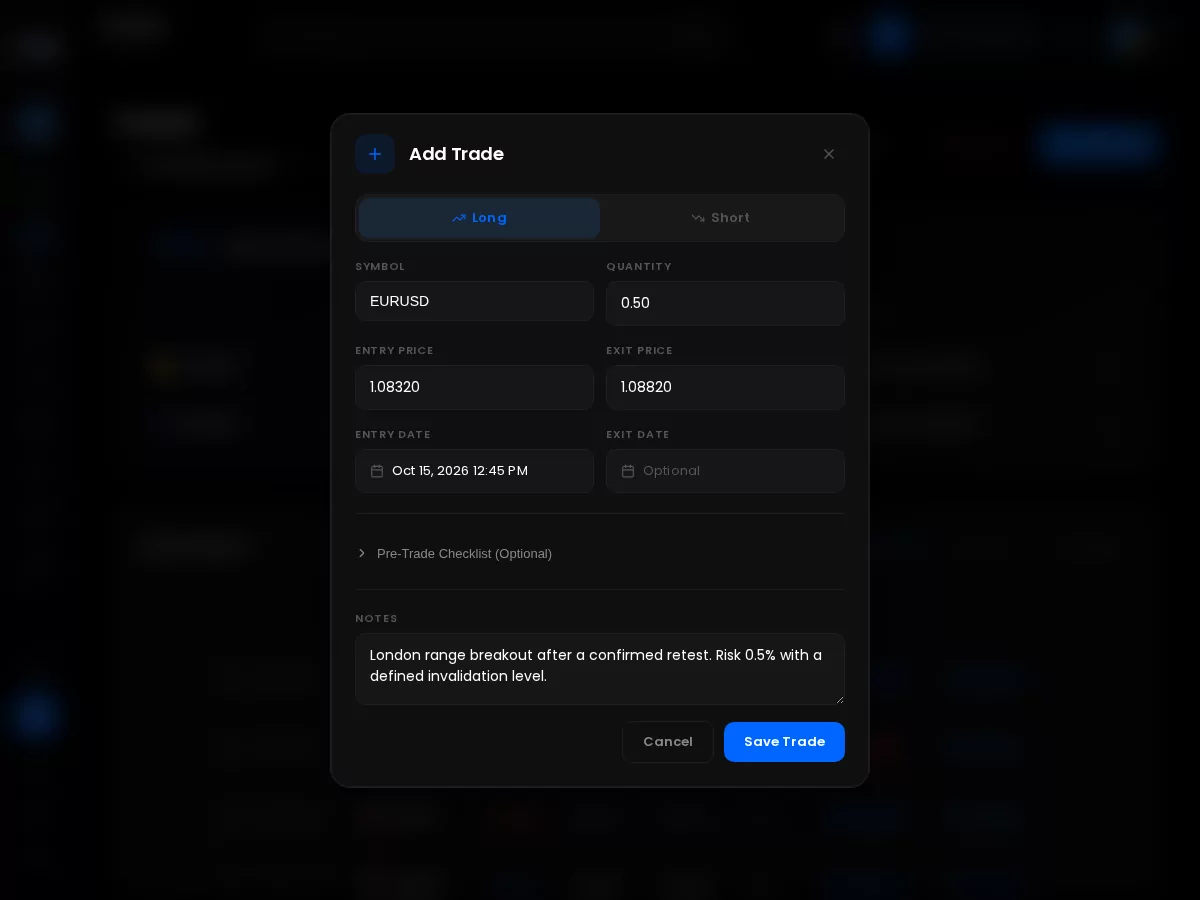
A short set of conditions to verify before a decision, such as the entry trigger, risk budget and scheduled news. It makes the intended process easier to repeat and review. Keep items observable, such as “initial stop recorded”, so a later review can tell whether the condition was met, independently of whether the trade won. Record the checks with your trade.
Commission
An explicit trading fee, often charged per lot or per side of a transaction. Include both entry and exit charges when calculating the complete cost of a round trip. A hypothetical $7 round-trip fee per standard lot becomes $1.40 on 0.20 lots; a fee quoted per side needs both sides included. Allow for costs when sizing.
Economic calendar
A schedule of economic releases, central bank decisions and other events relevant to markets. Times, forecasts and impact labels help organise preparation, but do not predict the direction of a price move. See the economic calendar.
Equity curve
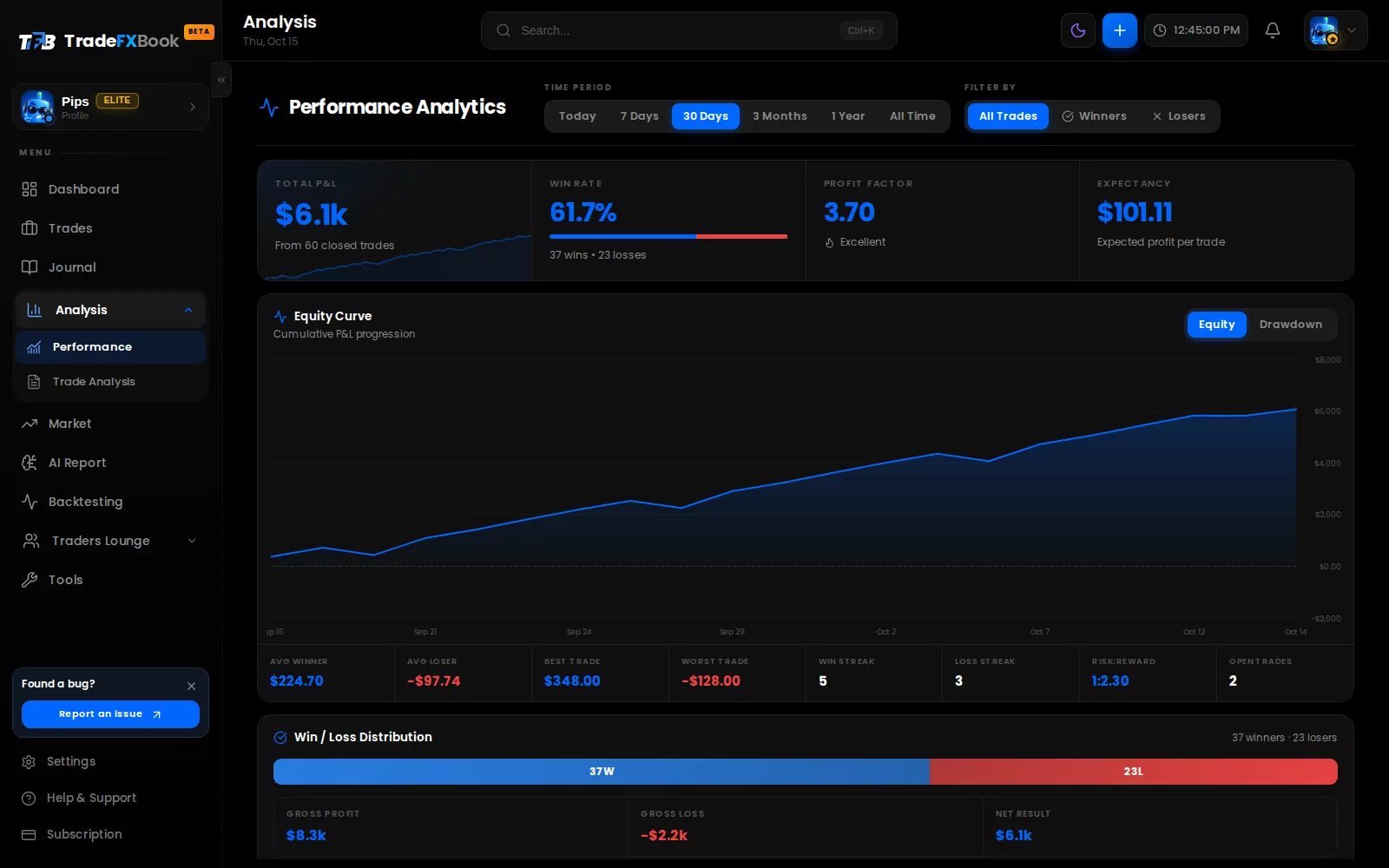
A chart of account equity over time, where equity includes unrealised P&L on open positions. Some reports instead plot cumulative realised P&L or closed-trade balance, so check the chart definition and the treatment of deposits and withdrawals. Explore performance charts.
Evaluation
A prop firm assessment with conditions such as a profit target, loss limits and permitted trading methods. Rules vary by firm, and completing an evaluation does not mean a backtested strategy will perform in the next account stage. Read about MetaTrader prop firm accounts.
Expectancy
The average outcome per trade in a defined sample, often expressed in cash or R. With all outcomes included, it equals net P&L divided by trade count; the sample average is an estimate, not a promise about the next trade. Work through an expectancy example.
Forward testing
Following fixed rules as new market data arrives, rather than evaluating only a historical sample. A demo account can support the process, though demo execution may differ from live execution. Plan the step after a backtest.
Funded account
A prop firm term for an account stage offered under its trading and payout conditions, often after an evaluation. Depending on the firm, trading may be simulated rather than placing the trader directly in control of live capital. See supported account connections.
High-impact news
An event a calendar provider labels as likely to attract substantial market attention, such as a major inflation release or rate decision. The label is an expectation, and actual volatility, spread and direction can differ. Prepare with the event calendar.
Investor password
A MetaTrader read-only account password that allows viewing account information and trading activity without permission to place trades. It is different from the master password used for trading. Read the MetaTrader connection guide.
Journaling
Keeping a record of the plan, execution, result and reflection for a trade. Consistent notes let you compare the decision you intended to make with the one you actually made. Start a trading journal.
Leverage
The relationship between market exposure and the margin required to hold it, often expressed as a ratio such as 30:1. More available leverage can permit larger positions, but it does not reduce the P&L of a given position for the same price move. Estimate margin for an exposure.
Liquidity
The ability to buy or sell near the available market price without a large price impact. Lower liquidity can contribute to wider spreads and worse fills, especially when orders are large relative to available quotes. Check the trading sessions.
Lot
A unit of trade quantity defined by the instrument’s contract specifications. Standard forex conventions use 100,000 base-currency units per lot, while metals, indices and other contracts may use different sizes. Turn lots into planned cash risk.
Margin
Collateral set aside to open and maintain a leveraged position. Required margin is different from the planned stop-loss amount and is not a cap on the possible loss. Use the margin calculator.
Margin call
A broker warning or demand for more collateral when account equity falls relative to required margin. Broker rules may instead trigger automatic position closures at a specified stop-out level, so a warning is not guaranteed before liquidation. Understand the margin inputs.
Max drawdown
The largest peak-to-trough decline observed during a specified period, measured in cash or as a percentage of the relevant peak. State whether the calculation uses balance or equity, since open losses can change the result. Check the recovery percentage.
Micro lot
Conventionally 1,000 units of a forex pair’s base currency, equal to 0.01 standard lots. On EURUSD in a USD account, that is $0.10 per pip when the standard contract is 100,000 units. Check pip value for a lot size.
Mini lot
Conventionally 10,000 units of a forex pair’s base currency, equal to 0.10 standard lots. For EURUSD in a USD account, its pip value is $1 under the usual forex contract convention. Calculate the pip value.
MT4
MetaTrader 4, a trading platform used by forex brokers for charts, orders and account history. TradeFXBook supports MT4 account sync on Pro and Elite. See the MT4 connection page.
MT5
MetaTrader 5, a separate MetaTrader platform used by brokers for trading and market analysis. An MT4 login is not interchangeable with an MT5 login; TradeFXBook supports MT5 sync on Pro and Elite. See the MT5 connection page.
Overlap
A period when two major regional forex sessions are active at the same time, such as London and New York. Exact overlap hours shift with local daylight saving changes. Check session overlap times.
Pip
A conventional unit of forex price movement, usually 0.0001 for pairs such as EURUSD and 0.01 for JPY pairs. EURUSD moving from 1.1000 to 1.1010 is a 10-pip move. Calculate the value of a pip.
Pipette
One tenth of a pip, often the extra decimal place in a forex quote. Ten pipettes make one pip; confusing the two can make a stop distance or pip-value calculation ten times too large or too small. On a five-decimal EURUSD quote it is 0.00001; on a three-decimal JPY quote it is 0.001. Check the pip convention.
Profit factor
Total profits divided by the absolute total of losses over a defined sample, using a consistent treatment of costs. Values above 1 mean profits exceeded losses in that sample; with no losing trades, the ratio has no finite denominator. Calculate it in a weekly review.
Prop firm
Short for proprietary trading firm; in retail trading, often a business offering evaluations and accounts governed by its own risk and payout rules. The account may be simulated, and the commercial terms vary between firms. Read about prop firm connections.
R-multiple
A trade’s outcome divided by its initial cash risk, where one R is the original risk unit. A $150 net profit against $50 of initial risk is +3R; keep the starting risk definition consistent. Read the R-multiples guide.
Risk to reward
The planned relationship between the loss at the stop and the gain at the target. A 20-pip stop and 40-pip target give a risk:reward ratio of 1:2 before costs, which says nothing by itself about the win probability. Compare stop and target distances.
Session
A regional period of trading activity, commonly described as Sydney, Tokyo, London or New York. Forex is decentralised, so session boundaries are conventions rather than a single exchange opening bell. See the forex market hours.
Sharpe ratio
A measure of average excess return relative to the standard deviation of those excess returns, using a defined benchmark, often a risk-free rate. Return intervals and annualisation assumptions must match; the ratio does not describe every kind of risk or reveal the largest drawdown. Review it alongside other measures.
Slippage
The difference between an intended or requested execution price and the price actually filled. It can be favourable or adverse, and an ordinary stop order does not guarantee its requested price. Allow for adverse fills.
Spread
The difference between the bid and ask quote at a given moment. It is part of trading cost and can widen with conditions; avoid deducting it twice when a result already uses actual bid and ask fills. Model spread in a backtest.
Standard lot
Conventionally 100,000 units of the base currency in a forex pair. One standard lot of EURUSD represents 100,000 EUR and is worth $10 per pip in a USD account under that contract convention. Check lot size and pip value.
Stop loss
An order intended to close a position when price reaches a specified adverse level. Depending on the order type and market conditions, the execution price can differ from the trigger price. Use a stop distance to size a trade.
Swap
In retail forex, an overnight financing adjustment that may be charged or credited for holding a position across a broker’s rollover. Rates, charge days and account arrangements vary, so use the actual statement adjustments in net results. Keep costs in the trade record.
Take profit
An order intended to close a position at a favourable target price, subject to its order terms and execution. A planned target is different from the profit actually realised after partial exits and costs. Record the actual quantity and execution price for each exit rather than assigning the original target profit to the whole position. Check the planned target.
Trade plan
A written set of rules for what to trade, when to enter, how much to risk and how to manage and exit the position. A useful plan is specific enough to check before entry and compare with execution afterward. Write a plan you can review.
Volatility
The extent of price variation over a specified period, measured in ways such as return standard deviation or a price-range measure. Higher volatility describes larger variation, not a reliable direction or a guarantee of opportunity. Relate stop distance to trade size.
Win rate
The proportion of trades classified as winners in a stated sample. State how flat trades are handled and read the figure with average win, average loss and costs; a high win rate alone does not establish profitability. Five winners among 12 trades give a 41.7% win rate, rounded, but the average win and loss determine how that sample adds up. Read win rate in context.