
Performance analyticsRead the numbers.
Read the numbers.
Return to the trades.
TradeFXBook shows P&L, win rate, profit factor, expectancy and equity and drawdown views.
Explore performance analytics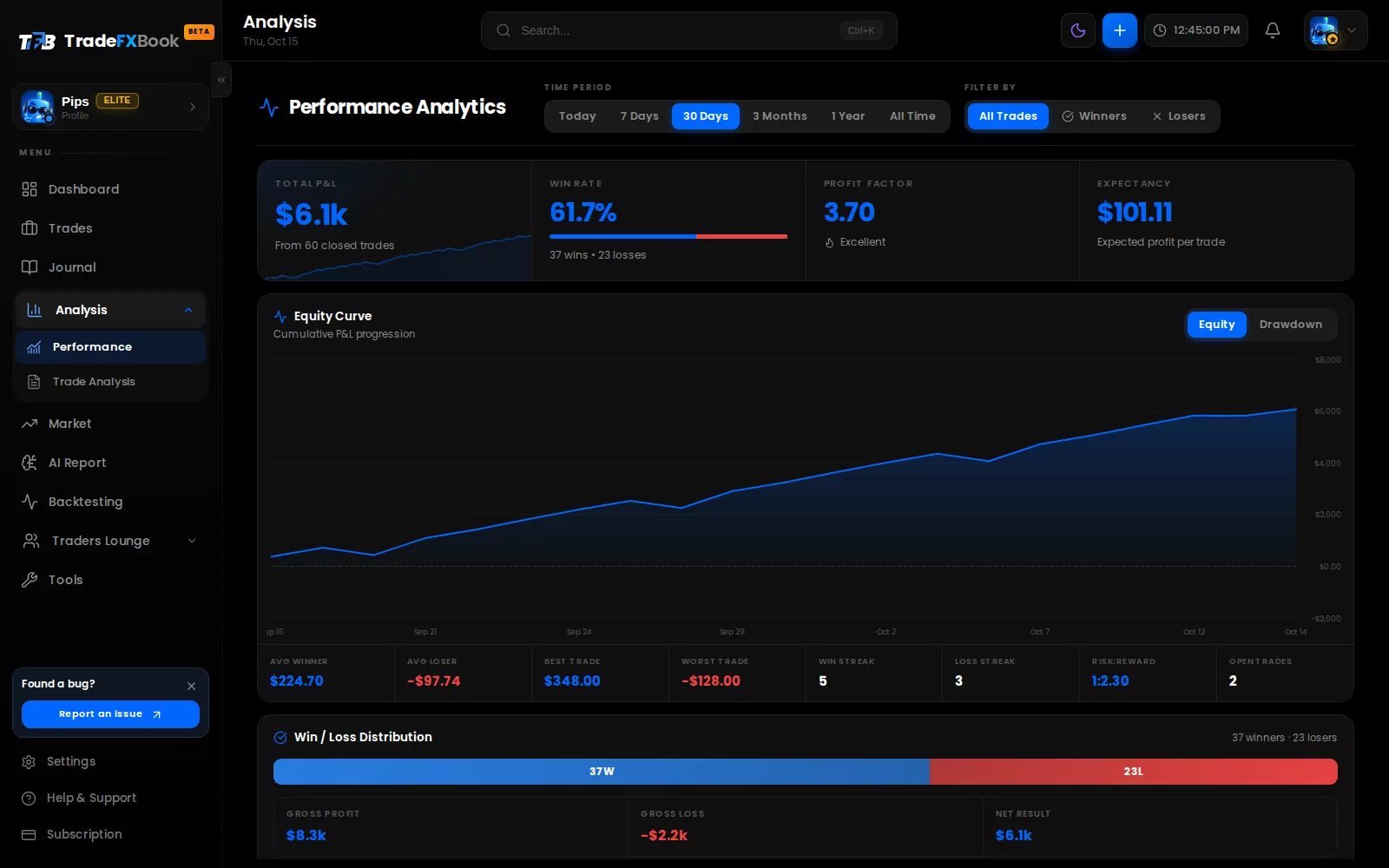
Forex trading guides
Reconcile the numbers, read the decisions and choose something specific to work on. A review should leave you with a clearer question for next week.
Choose the review window before opening the best or worst trade. Use the same timezone and the same rule for assigning trades to a week. Closed trades can be grouped by exit time; open positions need a separate note so unrealised gains do not quietly become realised performance.
Reconcile the trade list with the account statement. Check missing trades, partial exits, duplicate entries, commissions and overnight financing.
Keep deposits and withdrawals separate from trading profit.
A higher account balance after a deposit is not evidence of a better trading week.
If you use several accounts, review each one first. Mixing a demo account with a live account, or combining different account currencies without conversion, can hide what happened. You can compare the behaviour across them later, using a consistent measure such as R-multiples.
Read last week's action before calculating anything new. If you intended to wait for a confirmed entry, count how many eligible trades actually did. An unfinished action deserves an explanation. Replacing it with a new idea every Friday makes the review feel productive without showing whether anything changed.
Consider a hypothetical week of 12 closed trades. Five winners average $120 net and seven losers average $60 net in absolute value. Total gains are $600, total losses are $420, and net P&L is $180. Assume these results already include all trading costs, and that there are no flat trades.
This week made money despite losing more trades than it won. Win rate alone would miss that. Equally, one unusually large winner could make an otherwise weak week look healthy. Open that trade before deciding that the average represents a repeatable outcome.
One of those $120 net winners could be a hypothetical EURUSD buy of 0.30 standard lots at 1.09000, with an original stop at 1.08800. With a 100,000-unit contract in a USD account, each pip is $3. The 20-pip stop represents $60 of initial price risk.
An exit at 1.09420 earns 42 pips, or $126 gross. If the only additional charge is $6 commission, the recorded net profit is $120: +2R against the original $60 risk. This is one possible trade behind the average, not a claim that every winner followed this path.
Read its notes before drawing a lesson. A planned target reached with the correct size and an impulsive entry that happened to win can contribute the same $120 to the total. The numerical result cannot distinguish those decisions; your original plan and execution record can.
Read the drawdown and sequence too. If account equity peaked at $10,400 and later fell to $10,000, that decline was $400 ÷ $10,400 = 3.85%, rounded. The final weekly gain does not tell you how uncomfortable the path was. State whether your review uses closed-trade balance or equity including open positions, since the drawdowns can differ.
TradeFXBook shows P&L, win rate, profit factor, expectancy and equity and drawdown views.
Explore performance analytics
Compare results by symbol, session and weekday, then use your journal notes to explain the decisions.
Read every trade briefly, then spend longer on a few that explain a pattern. Include a planned loss, a planned win and a trade where execution changed. Choosing only the largest loss encourages you to judge a process by its most painful outcome.
For each example, compare the original plan with the actual entry, stop, size and exit. Was the setup present at the time? Was the risk calculated before entry? Did you follow the management rule? Could a reviewer see the same evidence in the screenshot without knowing the result?
Separate strategy questions from execution questions. A valid setup that reaches its original stop is evidence about the strategy. Entering before the trigger or widening the stop is also evidence about execution. Mixing those categories can lead you to change a strategy when the real issue was following it.
Compare only a few useful groups, such as setup, session or pair. Keep the trade count beside each result. Three London trades and nine New York trades are not equally informative samples. The difference might reflect news, market conditions or chance rather than the session itself.
Write the observation in plain language: “Four entries were taken before confirmation; all four were outside the plan.” That is firmer evidence for a behaviour check than “I should stop trading that pair.” It still does not prove what those trades would have earned under different execution.
Pick one response that fits the evidence and your existing risk limits. “Be more disciplined” is too broad. “Save the entry-trigger screenshot before every order” is observable. Write where you will record it and how you will count it at the next review.
For example, if eight of the 12 trades had the required screenshot, the completion rate was 66.7%, rounded.
Keep that count separate from win rate.
Next week, compare completed checks with eligible trades again, even if the number of trades changes. This measures the chosen habit directly instead of relying on whether the week happened to make money.
Keep a short summary with four lines: the review period, the main numerical result, the decision pattern and the next action. Add a question that remains open. For example: “Does waiting for confirmation reduce entries that fail the checklist?” That gives the next review a starting point without promising a financial result.
A single week is usually a small sample. Do not increase risk just because this one was profitable, or redesign every rule because it lost money. Compare the week with a longer period under the same rules. If a loss limit was breached, address that before looking for a new setup.
Also review the trades you deliberately skipped, if you recorded them at the time. A correct decision to stand aside can be part of following the plan. Keep those notes separate from executed performance so hypothetical winners do not enter your statistics.
End by preparing the next review window and carrying the action forward. The habit is simple: collect a complete record, ask a narrow question and return to it. The journaling guide explains what to capture so the next review has reliable material.
Yes. Note why no trades were taken and whether that followed the plan. There is no expectancy or win rate to calculate when there were no closed trades.
There is no universal number. A weekly review can check execution with a small sample, but claims about a strategy need more observations across relevant conditions.
First check data quality, execution and your risk limits. If you want to change a strategy rule, write the new version and test it separately instead of rewriting the old record.
Start your journal free. Make time to review.