
Free, self-guided challenge
30 days.
A clearer trading record.
A daily journaling task and a weekly review. Start whenever you like. This is a practice routine, with no competition, prizes or promised trading result.
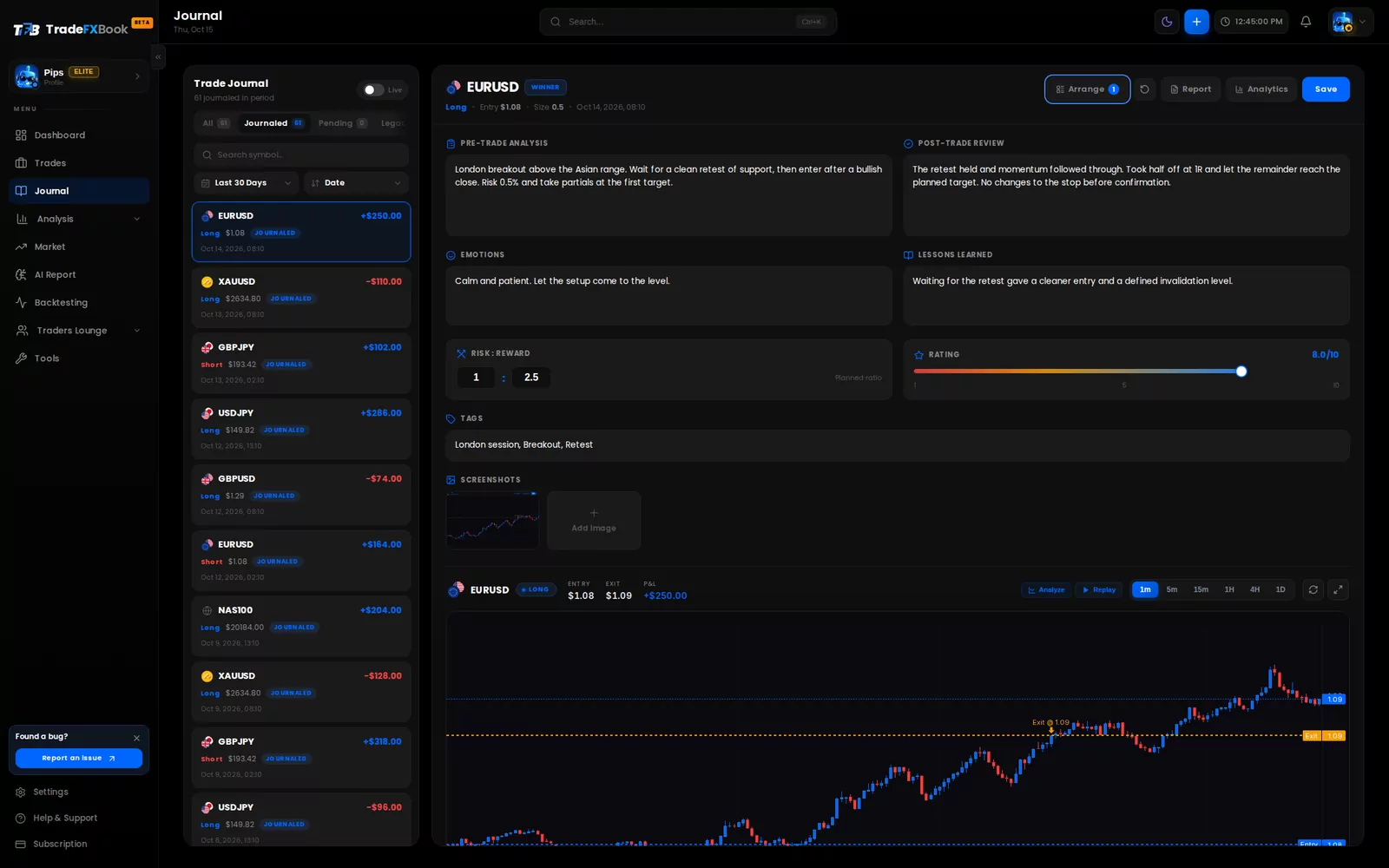
Use the trades you have.
No daily trading target.
You can complete the routine without taking a new trade each day.
| Your starting point | How to use the routine |
|---|---|
| Start on Free | Manual entry, journal notes, screenshots, ratings, 3 custom tags and analytics up to 1 month. Free includes 15 trades per month and the latest 15 in history. Keep a local copy of notes beyond that window; paid features are not required. |
| Keep no-trade days | Review an existing entry, refine the plan or keep working notes on why you stayed out. Do not trade to complete a prompt. Use the downloadable spreadsheet for records beyond Free’s allowance. |
| Keep it self-guided | No enrolment or daily submission. Return here for the next task and choose your own review time. |
One task each day.
One review each week.
Follow the days in sequence at your own pace, repeating a day when the record needs more attention.
Week 1: make a useful record
Why this week comes first. A review needs a record you can reconstruct. Facts, contemporaneous reasons and chart context come before comparing outcomes. Keep reconstructed notes labelled so hindsight does not silently replace the original decision.
- Day 1. Set up your journal. Choose an account and one account currency. Write what you want your reviews to answer.
- Day 2. Record a real closed trade using manual entry if needed. Check the symbol, direction, size, prices and costs.
- Day 3. Write the setup and entry reason in pre-trade analysis. Use the notes you made at the time; label anything reconstructed later.
- Day 4. Add a post-trade review. Compare the planned exit with the actual exit without rewriting the original reason.
- Day 5. Attach a screenshot to an entry. Include enough chart context to understand the setup later.
- Day 6. Add an execution rating out of 10 and a sentence explaining it. Separate the rating from profit or loss.
- Day 7. Review week 1. Check missing fields and unclear notes. Choose one change that will make next week’s entries more useful.
Keep from this week: A complete entry, with the original reason and the later review kept separate.
Week 2: describe the process
Why the process comes next. Consistent labels and execution checks let you compare decisions across entries. A profitable outcome alone cannot tell you whether you followed your rules. Use the same tag meanings and checklist wording throughout the review.
- Day 8. Choose up to 3 custom tags for the distinctions you need, such as setup or rule adherence. Use consistent names.
- Day 9. Apply those tags to entries you have already recorded. Keep the same meaning across trades.
- Day 10. Review the emotions field in an entry. Describe what you felt and the action it influenced.
- Day 11. Write a lesson learned from one entry. Make it a behaviour you can check, rather than a prediction.
- Day 12. Choose up to 5 important execution rules for your Free checklist template. Edit the labels to match your plan.
- Day 13. Review an entry’s execution checklist. Mark only the rules you actually followed.
- Day 14. Review week 2. Read notes from a winner and a loser if available. Compare execution before comparing results.
Keep from this week: A small, consistent set of tags and rules, with one specific lesson tied to an entry.
Week 3: put results in context
Why results wait until week 3. A chart or percentage becomes easier to interpret when you can find the trades and notes behind it. Compare trade counts with the result and keep observations tentative when the sample does not answer the question.
- Day 15. Open Performance analytics for the month. Read total P&L, win rate and the number of trades together.
- Day 16. Inspect the performance chart. Pick a change in the curve and find the trades behind it.
- Day 17. Compare results by symbol in Analysis. Note how many trades support each observation.
- Day 18. Review the session breakdown in Analysis. Compare your trading times with the sessions in your written plan.
- Day 19. Read the risk:reward notes in your journal entries. Distinguish the planned ratio from the realised R in your spreadsheet.
- Day 20. Find a trade with a strong result but weak execution, if one exists. Record the rule breach without excusing it.
- Day 21. Review week 3. Write one tentative observation and one thing the sample is too small to tell you.
Keep from this week: One observation supported by named entries, and one question that needs more evidence.
Week 4: test a review routine
Why only one change. A specific process change gives the next review something observable to check. Several simultaneous changes make it harder to connect a decision with the rule you intended to test. No-trade decisions also need a place in the review.
- Day 22. Choose one process change based on the reviews. Write how you will tell whether you followed it.
- Day 23. Check that change against a new or existing entry. Record evidence in post-trade review.
- Day 24. Read a previous lesson and the next relevant trade. Did the behaviour repeat or change?
- Day 25. Check today’s US high and medium impact events in Market. Write how relevant events affect your own plan.
- Day 26. Look for a valid no-trade decision. Record the reason in your working notes; do not create a dummy trade.
- Day 27. Revisit the written trading plan. Keep, revise or remove one rule based on the evidence you recorded.
- Day 28. Review week 4. Compare your first and latest journal notes. Keep the prompts that improved the quality of your record.
Keep from this week: A dated process change, evidence of whether it was followed and a revised plan if needed.
Days 29 and 30: keep what worked
Why finish with a routine. The month is a starting record, not proof of a trading edge. Keep the prompts that made entries clearer and choose a review time you can continue using.
- Day 29. Review the month. Write what you followed, what you missed and which observations need more trades before a conclusion.
- Day 30. Choose your next weekly review time. Keep one process change and a short set of questions for the next month.
Keep from this week: A next review date and one process change to carry forward.
Make a note you can check later.
Use the downloadable journal’s EX-002 as a writing example. Its entry note says “Entered before the planned confirmation.” The review says “Stopped at original level. Wait for confirmation.” The net result is -$102, but the action to review is whether the entry met the trigger.
On day 11, turn that into a lesson about waiting for confirmation. On day 22, define how you will check the same behaviour in the next relevant entry. On day 23, record the evidence. If no suitable trade occurs, review the existing note or keep a no-trade decision in your working notes.
If you miss a day, resume at the next unfinished task. Keep the sequence and use your own pace. Do not add trades to catch up or create dummy entries for planning notes. Free’s 15-trade monthly allowance is enough to practise reviewing existing entries; the 30 tasks do not require 30 trades.
Keep a simple
review kit.
The files stay useful after day 30.
Start with one
honest entry.
Start for free
Free includes 15 manual trades per month. Review at your own pace.