Choose a risk budget and a meaningful stop
Position sizing translates a planned loss into a trade quantity. Start with the amount you are willing to put at risk and the price that invalidates the trade. Calculate the size from those inputs. Choosing a familiar lot size first can make the same setup risk very different amounts as volatility changes.
For illustration, take a USD account with a $12,000 balance and a chosen price-risk budget of 0.5%. The cash budget is $12,000 × 0.005 = $60. That percentage is an example for the arithmetic, not a universal risk setting. Your own limits need to fit the account, open exposure and the losses you can tolerate.
Set the stop according to the trading rule. If a wider stop is needed, the size normally becomes smaller for the same cash budget. Do not move the stop closer simply to afford a larger position. A stop that no longer represents the setup's invalidation changes what you are trading.
Decide whether the budget is based on balance, current equity or another documented reference, and use it consistently. If open trades already have losses, balance alone may overstate the funds currently available. Keep any account-level daily or total loss limits separate from the per-trade calculation.
Calculate the pip value and lot size
Assume a standard forex lot is 100,000 units of the base currency. A pip on EURUSD is 0.0001. Multiplying 100,000 by 0.0001 gives $10 per pip per standard lot because USD is the quote currency. A 0.10-lot position therefore moves about $1 per pip in a USD account.
Suppose the planned EURUSD entry is 1.10000 and the stop is 1.09750. The distance is 0.00250, or 25 pips. With the $60 budget, the calculation is:
Lots = cash risk ÷ (stop distance in pips × pip value per standard lot).
Here that is $60 ÷ (25 × $10) = 0.24 lots, or 24,000 EUR. Each pip is worth $2.40, so a 25-pip move to the intended stop loses $60 before costs. If the stop distance doubled to 50 pips, size would halve to 0.12 lots for the same price risk.
Convert pip value into account currency
Currency conversion matters when the quote currency differs from the account currency. For USDJPY, a pip is usually 0.01 JPY. A standard lot has a pip value of 1,000 JPY. At an assumed USDJPY rate of 150.00, that is 1,000 ÷ 150 = about $6.67 per pip in USD. The value changes with the conversion rate; it is not always $10.
Work through the JPY conversion
For a second hypothetical trade, buy USDJPY at 150.00 with a stop at 149.70. The stop distance is 0.30 JPY, or 30 pips. Using the stated 150.00 conversion rate and the same $60 budget, size is $60 ÷ (30 × 1,000 ÷ 150) = 0.30 lots before costs.
The 30,000 USD position loses 9,000 JPY on that move. Converted at 150.00, that is $60. Converted at the stop rate of 149.70, it is about $60.12. This difference shows why a pip-value estimate at entry is not a fixed cash-loss guarantee when account-currency conversion changes.
Use the unrounded conversion value in the sizing calculation. Rounding $6.666… to $6.67 too early changes the intermediate result. Leave room for conversion changes and costs, then confirm the broker's actual volume increment before sending the order.
Use the pip value calculator to check the currency conversion. Confirm the broker's contract size and volume steps, especially for instruments other than standard forex pairs.
- Check the price-risk estimateUse cash risk, stop distance and account-currency pip value to calculate lots.
- Record the chosen sizeKeep the cash budget, original stop and sizing assumptions with your trade.
Position size calculatorCheck the inputs.
Then check the costs.
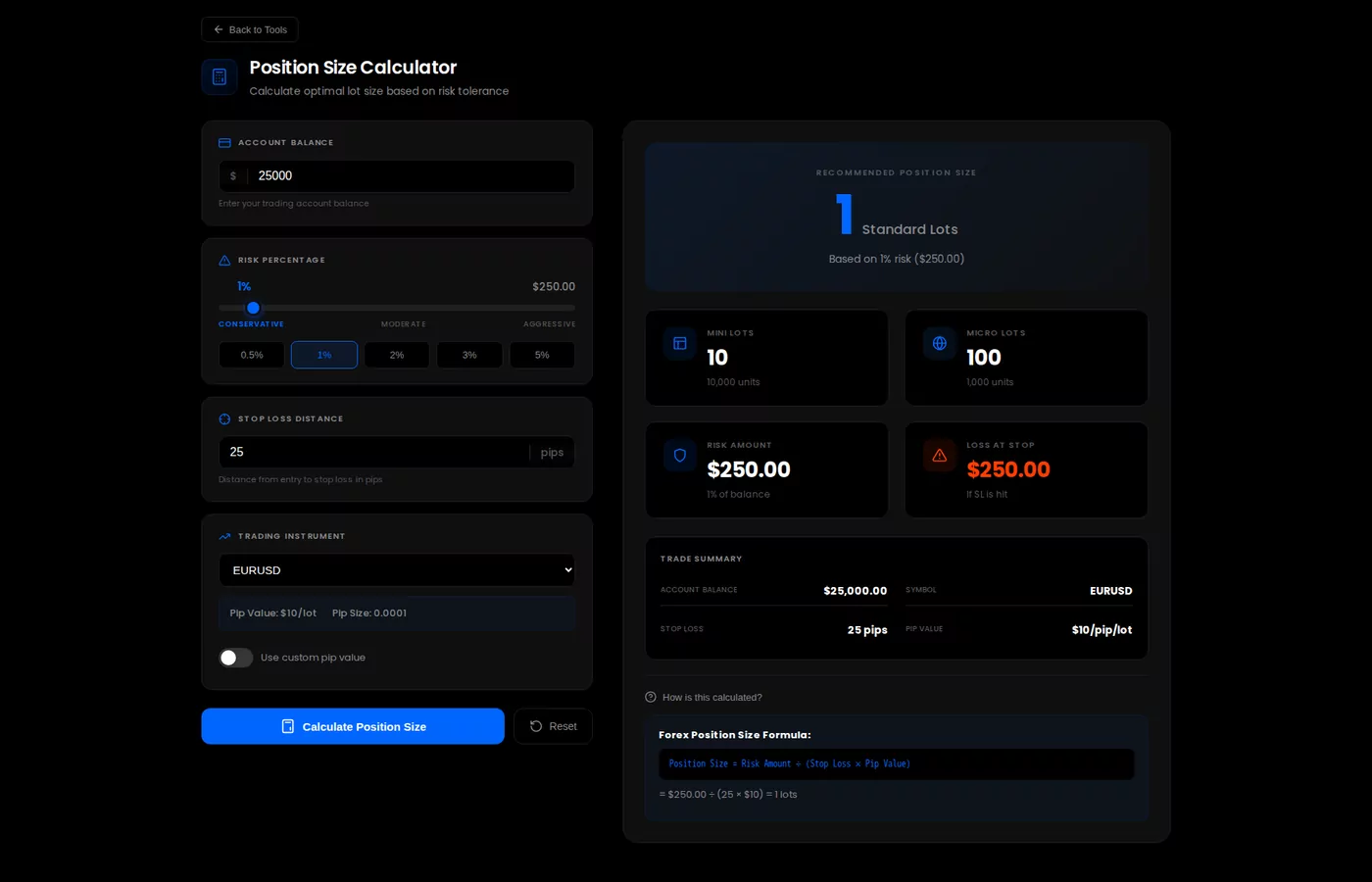
The example calculator screen shows the risk inputs and a calculated size. Commission and slippage still need a separate allowance.
Open the free position size calculator →
 ↗
Use the notes to preserve the risk budget, original stop and sizing assumptions that explain why you chose that position.
Allow for costs and round the size down
The 0.24-lot EURUSD example budgets only for the entry-to-stop price move. Commission, adverse execution and any spread not already reflected in that distance can make the actual loss larger. Check whether your entry and stop inputs represent executable bid or ask prices before adding spread again.
Suppose, hypothetically, the account charges $7 round-trip commission per standard lot. The trader also allows one extra pip for adverse execution. For one standard lot, the 25-pip stop is $250, the commission is $7 and the extra pip is $10. The combined estimate is $267 per lot.
To keep that estimate within $60, divide $60 by $267: about 0.2247 lots. If the broker permits 0.01-lot steps, round down to 0.22 lots. The estimated loss becomes 0.22 × $267 = $58.74. Rounding up to 0.23 would give $61.41, above the budget.
Know the limits of the estimate
A slippage allowance is an assumption, not a guarantee. A gap or fast market can produce a larger loss. If the smallest permitted position already exceeds your budget, the trade does not fit that budget. Reducing the size further may be impossible; skipping it is a valid outcome of the calculation.
The free position size calculator estimates price risk and rounds down to 0.01 lots. It does not include commission or slippage. When currencies differ, enter the conversion rate yourself; it has no live rate feed. Make the extra allowances separately.
Check margin and the rest of the account
Margin is the collateral required to hold a leveraged position. It is different from the intended stop-loss risk. At the example EURUSD entry of 1.10000, 0.22 lots represents 22,000 EUR, worth $24,200. With assumed leverage of 30:1 and a simple notional-based margin rule, required margin is about $806.67.
Your broker can apply different rates, tiers or conversion rules. Check its margin estimate before placing the order.
Having enough margin does not mean that the trade fits your risk budget.
Increasing available leverage can lower the collateral requirement without reducing the loss from a given price move.
Check combined exposure
Review combined exposure too. Two positions each risking $60 have $120 of planned price risk in total. If both depend on the same USD move, they may lose together. A separate pair name does not necessarily provide independent risk.
Check existing positions, pending orders and account loss limits before adding the new trade. Include the effect of open losses and costs where the account's rules require it. A margin estimate and a position-size estimate answer different questions, so keep both visible.
Finally, record the inputs before entry: account reference amount, cash budget, stop, pip value, size and cost assumptions. Compare those with the actual execution afterward. The journaling guide shows how to keep the plan beside the result.